
Clay County Death Index Lookup
Clay County Death Index work usually starts in Celina, where the health department and county clerk handle the first layer of local questions. Clay County is a small county, but the record trail can still split in two directions fast. A recent death certificate may come through the state system, while a historical index hit may point you toward TSLA or a county office that can explain the next step. If you are trying to confirm an older family death, the county's value is in its direct, practical access. It gives you a local office to call and a historical range to test before you widen the search.
Clay County Death Index Sources
The Clay County Health Department at 115 Guffey Street in Celina is the county's direct health-record contact. Research notes say the office can issue death certificates for any Tennessee death through the state's electronic issuance system. That makes the Clay County Death Index useful even when the death did not happen in Clay County itself. If you know the county of residence, the approximate date, or the family name, the health department can often tell you whether you should ask for a certified copy or keep working from the index.
The Clay County Clerk at P.O. Box 218 gives administrative help and can explain how residents should approach vital records, but it does not issue death certificates. That separation is easy to miss if you are new to Tennessee records. For Clay County Death Index research, the clerk is part of the local map, while the health department is the place that can actually handle a recent certificate request. Together, they are the two most useful county offices for a search that begins with a name and ends with a copy.
Clay County Death Index at TSLA
The Tennessee State Library and Archives holds the historical Clay County Death Index material. Its county and statewide guides show that death records from 1908-1912 and 1914-1975 are available in the historical run. That gives Clay County researchers a long window, but it also leaves the 1913 gap. If the death you need falls in that year, the county index may not be enough. In that case, turn to cemetery inscriptions, old newspapers, church books, or probate references to keep the search alive.
TSLA is especially useful when the Clay County Death Index entry is partial. A record may appear with only a surname, a year, and a certificate number. That is still enough to build a better search. If you can add the county and a likely three-year range, the TSLA staff or the online index is much easier to use. The goal is not to get every answer at once. The goal is to get one reliable lead that you can carry into the next record set.
The Tennessee certificate guide at How do I get my certificate is the state source that matches this image and shows the request routes that support both local and statewide Death Index searches.
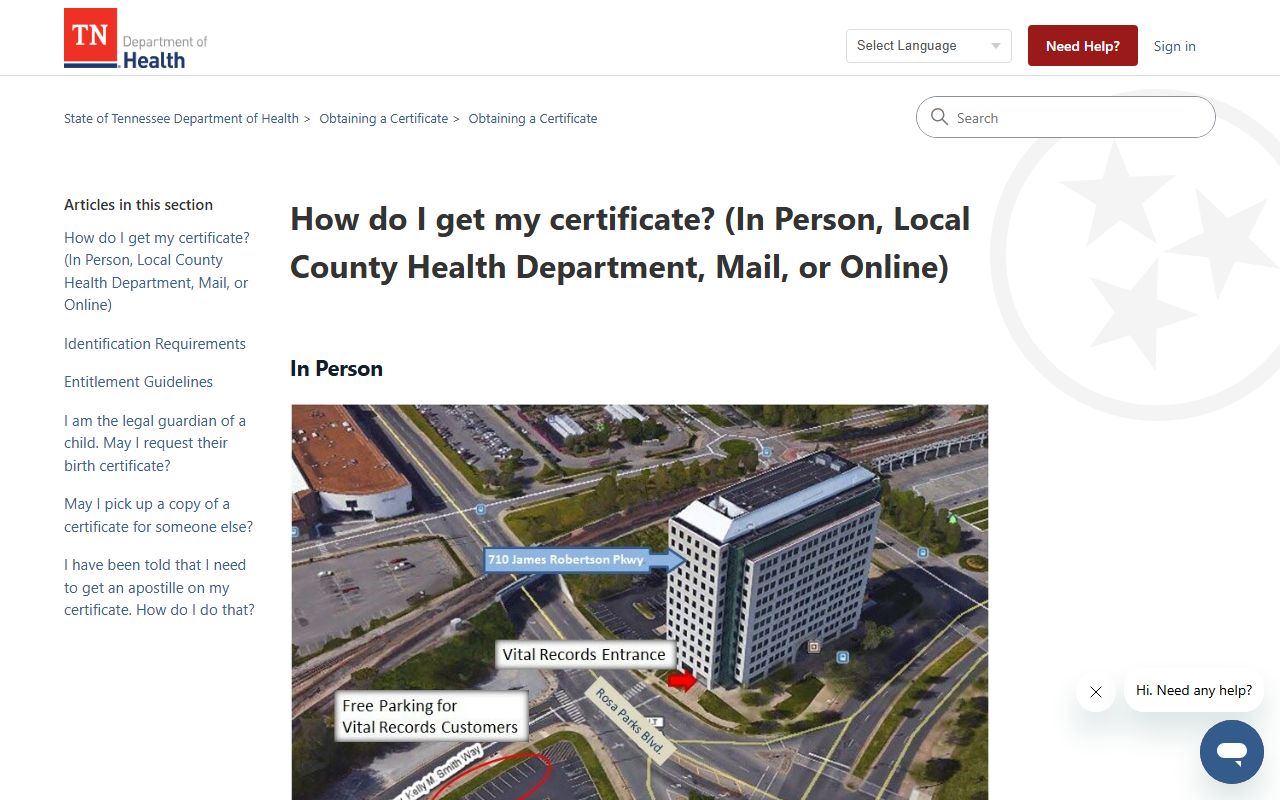
That state guide fits Clay County well because it shows the request routes that support both local and statewide Death Index searches.
Clay County Death Index Requests
Recent Clay County Death Index requests follow the statewide rules. The Tennessee Office of Vital Records state portal and its request guide explain the in-person, mail, and online methods. Because any county health department can issue a registered Tennessee death certificate, you can often ask close to home instead of going to Nashville. That is useful in a county like Clay, where one office visit can be enough to move from an index entry to a certified copy.
The standard fee is $15.00 per certified copy, and the state applies entitlement rules before releasing a recent certificate. The guidelines explain who qualifies and what proof the office may ask for. If the death record is older and public, a Clay County Death Index hit can point you toward a historical copy. If it is recent, the request has to go through the proper entitlement check first. That difference is the core of Tennessee vital records work.
Clay County Death Index and Public Records
The public records side of a Clay County Death Index search is governed by two ideas at once. The CTAS public records guide says county records are open unless another law says no. But the Vital Records Act keeps death certificates confidential for a set period and limits who can ask for cause-of-death data. Those rules appear in T.C.A. § 68-3-205 and § 68-3-206. In practice, that means the index may be easier to access than the certificate itself.
CTAS also says county offices should answer requests within seven business days. That gives Clay County researchers a useful timeline when they ask the clerk, the health department, or the archives to check a name. If the office cannot release a record, it should still explain the rule behind the refusal. That keeps the search on track and helps you decide whether you should use a local office, the state office, or TSLA next. The law is not a wall. It is the guide that tells you which door is open.
What Clay County Death Index Records Show
A Clay County Death Index entry is often brief, but it still gives you a strong start. The entry may show the decedent's full name, county of death, year, and certificate number. Once you get the full certificate, the record may add age, sex, date of death, place of death, burial details, and informant information. Those pieces matter because Clay County families often reused names over time. A strong index hit can stop you from mixing one cousin with another.
If the name looks wrong, keep digging. A Clay County Death Index may list a married woman under a husband's name or use initials instead of a full given name. A child may appear as an infant with little detail attached. That is why a good search uses more than one clue. Compare the index with family notes, cemetery records, church rolls, or old newspaper notices. The index gets you close, but the county story only makes sense when the other records fill in the space around it.
More Clay County Death Index Clues
Celina's local offices can still help after the index search. The clerk can explain how records are handled in the county, and the health department can tell you whether a certificate is still restricted or ready to request. For older work, TSLA is the more useful stop because it holds the historical set that many Clay County Death Index searches rely on. A good searcher's habit is to keep the local office names, the historical year range, and the certificate number together in one note.
The county's small size can work in your favor. Fewer moving parts often means fewer places to check for the same death, so a Clay County Death Index search may resolve faster than one in a larger county. Still, do not stop at the first hit. Test the date, compare the surname, and look for any land or probate clue that might prove the match. The best local searches are the ones that turn a short index line into a verified record trail.