
Search Knox County Death Index
Knox County Death Index research is often stronger than it first looks, because Knoxville kept death records before statewide registration and the county still keeps several useful record paths open today. A recent certificate may come from the health department, while an older family death may sit in TSLA or the Knox County Archives. The county also has a register of deeds office that can help when an estate changes land records after a death. If you know the name and the rough year, Knox County gives you a practical starting point. The challenge is choosing the right office, then moving from index hit to certified copy or archive record.
Knox County Death Index Sources
The Knox County Health Department Vital Records Division at the county vital records page is the main place to start a recent Knox County Death Index request. The main office at 140 Dameron Avenue in Knoxville handles both birth and death certificates, while the West Clinic at 9000 Executive Park Drive handles birth certificates only. That split matters. If you need a death certificate, the main office is the right stop. The department issues death certificates for Tennessee deaths within the last 50 years, and it accepts walk-in, mail, and online requests.
The county page also gives the practical details that make the search easier. The fee is $15.00 per certificate, with a small card fee for credit transactions and a returned-check fee if payment bounces. Recent death requests should wait at least two weeks after the date of death so the record can be processed. For a Knox County Death Index search, that means you can often confirm the office, then decide whether the record is ready now or whether you should come back after the county system catches up.
Knox County also matters because it has a long record memory. The county archives at 601 S. Gay Street hold limited birth and death records for Knoxville dating back to 1881. Those are not certificates, but they can still help you place a name, match a family line, or decide which year to test next. In a county this large, that extra historical layer is often the difference between a loose guess and a solid record trail.
The first Knox County image comes from the records management page at Knox County Records Management, which is the county's historical doorway into death record research.
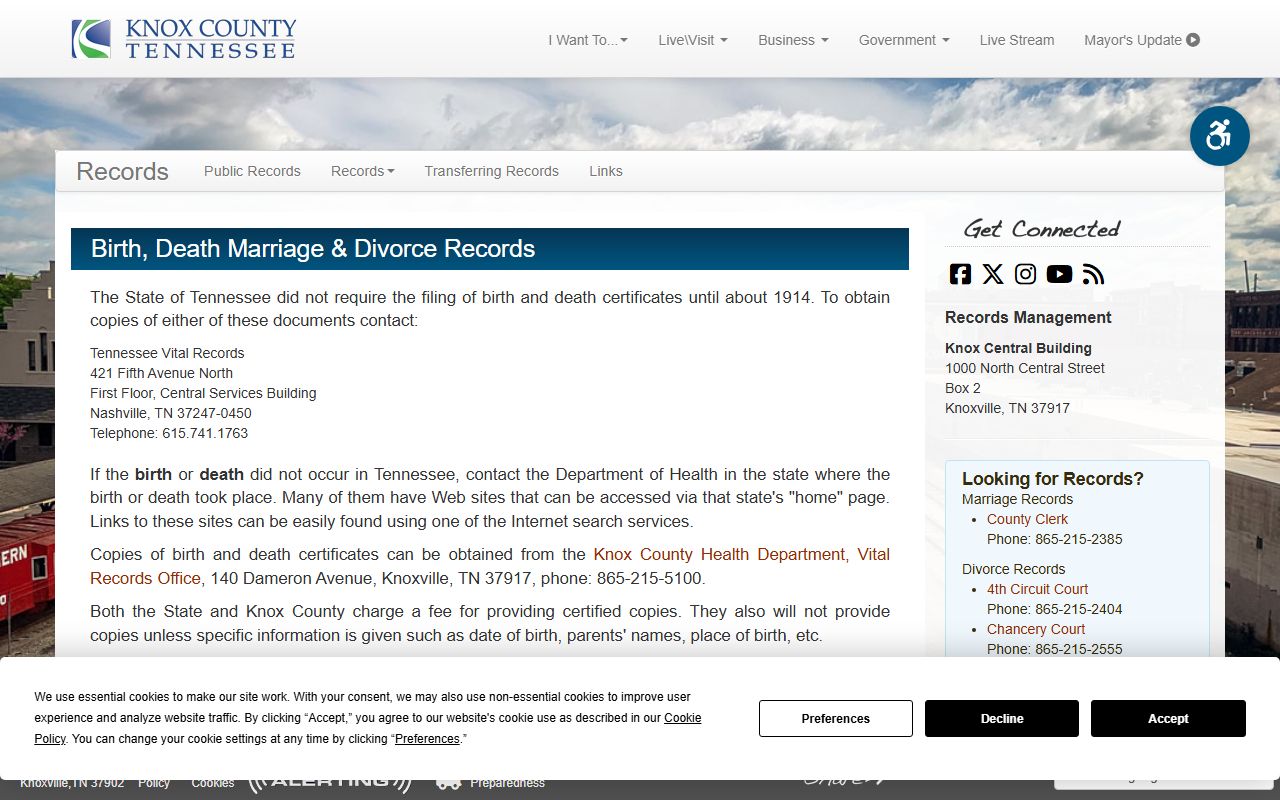
That county records page is useful when the death is old enough to need an archive-style search instead of a fresh certificate request.
Knox County Death Index at TSLA
Historical Knox County Death Index work often moves from the county office to the Tennessee State Library and Archives. Knoxville began keeping death records in 1881, before statewide registration took hold. TSLA says those early Knoxville death records are available, but they are not indexed. That means you need more than a surname if you want TSLA to search. Give them a date, the city, and the spouse name if you know it. A one-year search is much more realistic than a broad guess.
The TSLA research guide at tsla.gov is the best statewide guide for the historical side of a Knox County Death Index search. It explains that Tennessee death records from 1908-1912 and 1914-1975 are in the historical set, and it also explains the 1913 gap. For Knoxville and Knox County, that gap still matters. If a family story lands in that year, check newspapers, cemetery books, church material, and the county archives before you assume the record does not exist.
The state guide also helps when a name is close but not exact. A woman may appear under a husband's surname. An infant may be indexed as an infant of the family. Older records can also shift spellings. That is why a Knox County Death Index search often works better when you search more than once and keep each near match until the names, dates, and places line up.
Knox County Death Index Requests
When you need a current certificate, the Tennessee Office of Vital Records main portal is the statewide entry point. The state explains the in-person, mail, and online request methods in its certificate guide. Tennessee also allows county health departments to issue death certificates for any death registered in the state through the electronic system. That means a Knox County Death Index search can start at the local health department without forcing you to go to Nashville first.
The state fee schedule still matters. The standard fee is $15.00 per certified copy, and a no-record result still carries the same base charge. If you need a recent record, the entitlement guidelines tell you who can request it and what documents may be required. Immediate family, legal representatives, executors, beneficiaries, and funeral directors may qualify, but the office checks the paperwork before it releases the record. In Knox County, that paperwork check is usually faster when you already have the index hit and certificate number.
Knox County Death Index and Public Records
Public records law and vital records law overlap in Knox County, but they do not do the same job. The CTAS public records guide explains that county records are generally open during business hours unless another law keeps them closed. Death certificates are one of the records that remain restricted for a time under the Vital Records Act. So a Knox County Death Index entry may be public before the full certificate is. That split is normal, and it is the reason the index is so useful.
Under the entitlement rules, recent death certificates are limited for privacy reasons, and cause-of-death data is even more controlled. That means the county may confirm that a record exists without handing out the full file to everyone. CTAS also notes that county offices should respond to records requests within seven business days. That gives you a realistic timeline when you contact the health department, archives, or register of deeds about a Knox County Death Index matter. You may not get the answer you want, but you should get a clear answer.
What Knox County Death Index Records Show
A Knox County Death Index entry usually gives you the basic facts first. That may include the person's name, date of death, county of death, and certificate number. Once you move from the index to the full certificate, the record often adds age, sex, residence, place of death, burial details, and the informant. Those fields matter because Knox County families can be large and spread across city and rural lines. One clean certificate can settle a question that a dozen family trees leave open.
The record is also useful because it connects to other county systems. The Knox County Register of Deeds is not a vital records office, but it can help when a death is followed by a deed transfer or an estate step. In a large county like Knox, that link is important. A death record, a property record, and an archive record can point to the same family event from three different directions. Together they create a better proof set than one index line by itself.
The second county image comes from the Register of Deeds, which is where property and estate paper often become part of a Knox County Death Index search.

That office is not the certificate source, but it is often the next stop after a death changes ownership or settles an estate.
More Knox County Death Index Clues
Knox County Archives can be a strong companion to the Death Index. The archives keep limited birth and death records for Knoxville dating back to 1881, and those records are often enough to narrow a search when the modern certificate is still restricted. If the name is common, start with the year, then the place, then the family role. A small bit of context can keep you from chasing the wrong Knox County family line.
Use the county's local office mix to your advantage. The health department handles current certificates. The archives help with older Knoxville material. The register of deeds helps with property and estate work. TSLA handles the historical state set. In practice, a good Knox County Death Index search moves through those four layers in order. That is faster than guessing, and it gives you a record trail you can trust.