
Search Moore County Death Index
Moore County Death Index research usually starts in Lynchburg, where the health department and county clerk are the first local offices to check. The county is small, but the record trail can still split between recent certificate requests, older family records, and historical state files. If you already know the name and rough year, Moore County gives you a clean path: first the health department for current records, then the clerk for family context, then TSLA for the older public record set. That keeps the search tight and local, which matters when a small county has just enough records to answer a question if you ask in the right order.
Moore County Death Index Sources
The Moore County Health Department at 2052 Hospital Boulevard in Lynchburg is the local place to start a recent Moore County Death Index request. Research notes say the office provides public health services and can issue death certificates through Tennessee's electronic vital records system. That means the county can often handle a recent request without sending you elsewhere. If the death falls within the restricted period, the health department is the office that can process the certificate after checking entitlement.
The Moore County Clerk at Public Square in Lynchburg gives the county its administrative base. That office does not issue death certificates, but it matters because it keeps the county record structure organized and also maintains marriage records from 1872. Those marriage records are important in Moore County because they can help prove the family line behind a death certificate or an index hit. In a small county, the same surname can show up in several branches, and the marriage trail helps sort them out.
Because Moore County has no local county image in the manifest, this page uses a state-level image from the Tennessee Office of Vital Records entitlement page. The entitlement guidelines are the right statewide companion for Moore County Death Index research.
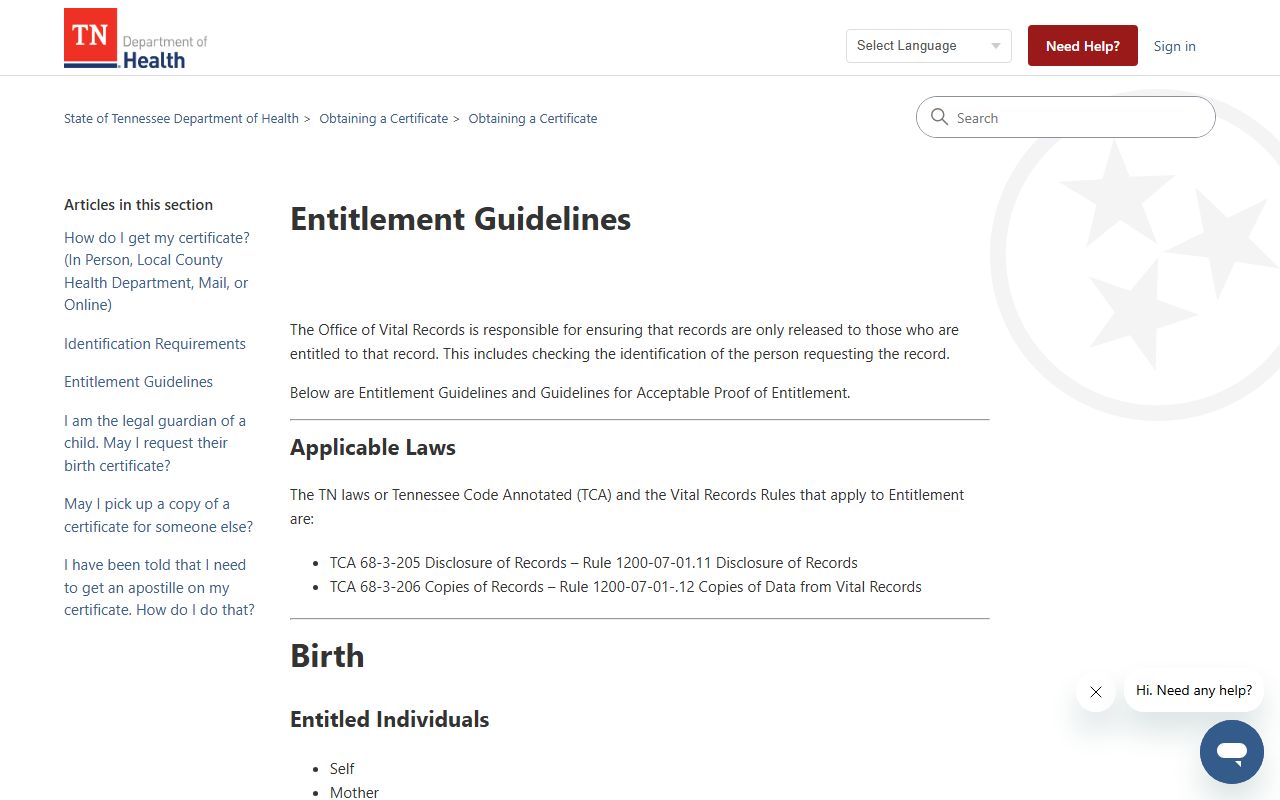
That image fits Moore County because request eligibility often decides whether the certificate can be released right away.
Moore County Death Index at TSLA
Historical Moore County Death Index work belongs with the Tennessee State Library and Archives. TSLA says death records for Moore County from 1908-1912 and 1914-1975 are available in its holdings. That historical range is the heart of the search when a death is old enough to be public but not easy to confirm through a county office. The 1913 gap still applies, so if a family story lands in that year, you need backup sources like cemetery records, newspapers, or church notes.
The TSLA guide at TSLA vital records guide helps you shape the search. A Moore County Death Index query works best with a full name, county, and short year range. The narrow range matters because it keeps the search from drifting. Once you get a certificate number, hold on to it. That number makes later copy requests easier and gives you a stable reference if you need to share the result with another family member or researcher.
Moore County Death Index Requests
For a recent certificate, the Tennessee Office of Vital Records main portal is the statewide starting point. The state explains the in-person, mail, and online request methods in its certificate guide. Tennessee also lets county health departments issue death certificates through the electronic system, so a Moore County Death Index request can often stay local if the record is recent and the requester is entitled to receive it.
The standard fee is $15.00 per certified copy, and the office may still ask for proof of entitlement before release. The entitlement rules matter because they tell you who can request the record and what documents may be needed. In Moore County, that is especially helpful when the clerk's marriage records and the health department's certificate request are part of the same family search. If you know the relationship, the request is easier to make and easier for the office to verify.
Moore County Death Index and Public Records
The public records side of a Moore County Death Index search follows the same Tennessee law used across the state. The CTAS public records guide explains that county records are generally open during business hours unless another statute keeps them confidential. Death certificates are one of the records that stay restricted for a time, so a Moore County Death Index entry may be public before the full certificate is. That is why the index is often the best first step.
CTAS also says county offices should answer records requests within seven business days. That gives you a clear expectation when you contact the health department or clerk. The office may confirm the record, deny it, or tell you where the public copy lives. For Moore County Death Index work, that kind of response is useful because it keeps the search in the right lane and helps you decide whether the next step should be a county office, the state office, or TSLA.
What Moore County Death Index Records Show
A Moore County Death Index entry usually gives you the key facts first. The name, date of death, county, and certificate number are the pieces that move the search forward. Once you get the full certificate, the record may add age, sex, residence, place of death, burial details, informant, and cause of death if you are entitled to it. Those details matter in a small county because they help you separate one branch of the family from another and prove that you have the right person.
The marriage records at the clerk's office can help make that proof stronger. A marriage record can place a person in a household, tie a spouse to a death certificate, or explain why a surname changed. In Moore County Death Index research, that family link can be as important as the certificate itself. If the name is common, compare the death entry with marriage history and cemetery data before you decide the search is finished.
More Moore County Death Index Clues
Moore County's small size can work in your favor. The record set is not huge, which means a tight search often gets you to the right result faster. The health department handles current deaths. The clerk handles marriage history and county administration. TSLA handles the historical public record set. That simple structure is often enough for a Moore County Death Index search if you keep the date range narrow and the county fixed.
If the first search misses, shift the year slightly and try again. Small counties can still have spelling changes, missing initials, or an index line that uses a different form of the name. Keep the county record trail together in one note so you can compare it later. That is usually the fastest way to turn a short death index entry into a reliable family record.